|  | | | |  | |  |  | My ballistic gelatin substitute: |  | |  |  | |
 Posted: Tue Jan 10, 2012 9:21 pm Posted: Tue Jan 10, 2012 9:21 pm |
 |
|
| radar |
| Silver Status Member |

 |
|
| Joined: 13 Nov 2011 |
| Posts: 1138 |
| Location: Des Moines, Iowa, USA |
|
|
|
Hey, all, I’ve seen a lot of clay and soap shot up on Youtube and the medias used, including wet phone books and newspapers are usually too dense to
Simulate ballistic gelatin or animal tissue. Well I don’t ever buy gelatin (yet) and mess with all that, but this is the way I simulate it. I have done this with pellet guns and firearms for years, and feel that I have have seen excellent correlation with this method, if done correctly, to calibrated ballistic gelatin, as well as post-mortems from the hunting field. (And morbidly, from coroners’ reports.)
Plus it is cheap and easy.
1. I take one or more packages of 4-fold paper napkins about 16 inches long when dry and
place them in a cardboard or wooden box withan open top and one end opened up. If cardboard, I
put it in a plastic trash bag to keep the box dry and intact:

2. The top of the plastic wrapping the napkins is cut wide open so I can pour in about 1-1/2 to 2 gallons of water.
I leave the wrapping on the ends so the napkin wrapping can partially fill with water because it helps the bottom
of the napkins soak up water evenly, then let it set a few minutes:

3. I use a multipump pellet/BB gun as a calibrator. At 6 pumps, this one chronographs 608fps with a steel BB:

4. When the water has thoroughly soaked into the napkin pack, I stand the pack on each end alternately, to let its own
weight squeeze out the excess water and compress the pack somewhat. Then I cut the plastic wrapping off the shooting end
and see that a BB shot into the bare pack at 600fps penetrated the “FBI gelatin calibration” depth of 3-1/4 to 3-3/4 inches.
This is the depth probe I use to determine depths to the back of the calibration BB, and later, the pellets:
(This BB went about 3-1/4” inches)

This pack ended up about 11 inches thick from its own weight. (remember both sides so it compresses evenly throughout:
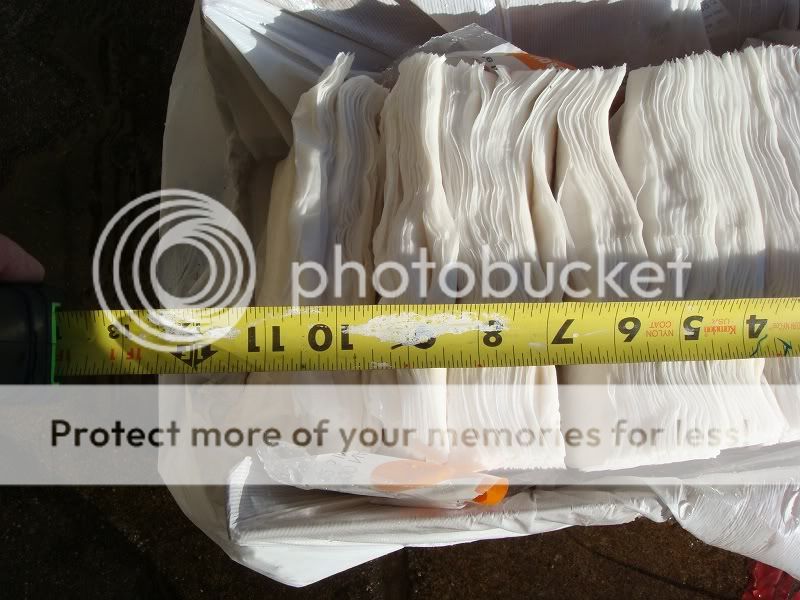
I use an old pair of jeans to put a double layer of denim over the shooting side to simulate hide:

After probing depth and compensating for the approximate length from the back to the nose of the pellets and writing down
the results, they can be removed for inspection, and the “wound” channel inspected for permanent cavity size along its length.
I usually get 5 to 8 shots into it with air rifles, but not so many as to allow the channels to cross or get too close to each other, as that
would skew the results:

Here are the recovered pellets, exept for the RWS Superpoint Extra, which I forgot about. There was no significant expansion at the
velocities I shot them. Some HPs do expand nicely in the pack, but these are domed except for the Premiers. The Premiers are a rather
hard alloy and that is fine with me. In a .22, I figure my hole is big enough and I want reliable penetration first and foremost:

These are the performance parameters and results for this test:
Benjamin Discovery, .22 cal:
JSB Domed 18.13gr @ 815fps, 26.7fpe = 7.7” depth
Premier Domed HP 14.3gr @ 870fps, 24.0fpe = 6.6” depth
RWS Diana 34, .22 cal:
JSB Domed 18.13gr @ 680fps, 18.6fpe = 5.9” depth
Premier Domed HP 14.3gr @ 755fps, 18.1fpe = 5.3” depth
RWS Superpoint Extra 14.5gr @ 725fps, 16.9fpe = 5.1” depth |
|
_________________
It's never too late to have a happy childhood. |
|
|
|
|
|
| |  |  | | | |  |  |
Note: If you are seeing "Please enter your username and password to log in." Your browser cookies have been reset
or you need to register to access the topic in question. Use the 'Register' button near the top left of this page.
|